


Homemaking as Creative Practice

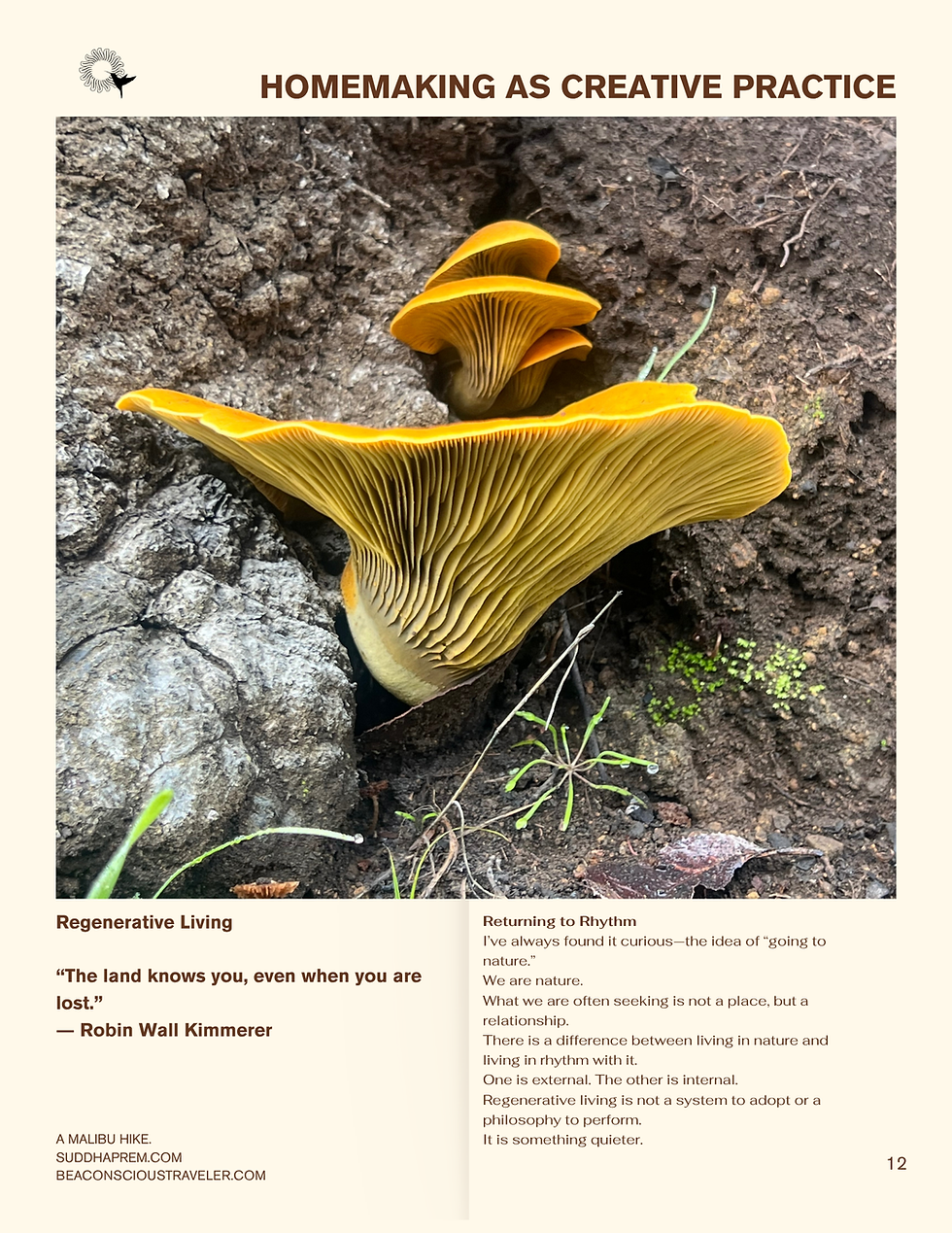
Returning to Rhythm
I’ve always found it curious—the idea of “going to nature.”
We are nature.
What we are often seeking is not a place, but a relationship.
There is a difference between living in nature and living in rhythm with it.
One is external. The other is internal.
Regenerative living is not a system to adopt or a philosophy to perform.
It is something quieter.
A remembering.
A remembering that life moves in cycles.
That energy is not linear.
That growth does not always look like accumulation.
It asks us to slow down enough to notice what is already speaking: the seasons, the soil, the body, the spaces we inhabit.
In this way of living, sustainability is not a goal to reach.
And over time, something begins to soften.
The urgency to control softens.
The need to extract dissolves.
The separation between “life” and how we live it dissolves too.
What remains is something quieter—a sense of participation in something already in motion.
The Home as a Living Practice
Homemaking, then, becomes an extension of this rhythm.
Not a task. Not an aesthetic to perfect. But a creative, living practice.
I think of my childhood in Cuernavaca, the city of eternal spring— where doors were often open, and the boundary between inside and outside barely existed.
My mother moved through the kitchen with a kind of quiet devotion.
There was always something growing, something simmering and baking, something being tended to.
It wasn’t presented as ritual.
It simply was.
Fresh herbs on the table.
Fruit ripening by the window.
The rhythm of meals shaping the rhythm of the day, and the seasons.
Looking back, I understand now—that was homemaking.
Not as perfection, but as presence.
And perhaps this is what we are really honoring in quieter ways—not only motherhood as a role, but as a way of being.
The quiet, often unseen gestures of care.
The hands that nourish, tend, and create space for life to unfold.
In many ways, our homes carry these imprints—of those who came before us, of the ways we were held, fed, and taught to see the world.
A home is not built all at once.
It is shaped slowly—through gestures, through attention, through care.
Through the way light enters a room.
Through the meals prepared in the kitchen.
Through the objects we choose to keep close.
When approached this way, the home becomes more than a place.
It becomes a space of return.
A place where beauty is not imposed, but revealed.
A Gentle Practice of Living Well
These are not rules, but invitations—a kind of quiet toolbox you carry with you:
Reflect your current self
Let your home evolve with you. Release what no longer feels true.
Set intentions
Let your space support how you want to feel—grounded, calm, alive.
Create space for calm
Clear surfaces. Simplify. Let the mind rest where the eye can rest.
Embrace slowness
Move away from perfectionism. Toward comfort, presence, and ease.
Curate, don’t accumulate
Choose objects with meaning. Let them tell a story. Let them breathe.
Layer with life
Bring in natural textures—wood, linen, plants. Let the space feel alive.
Create a small altar
A corner of stillness. A place for reflection, beauty, and memory.
Daily Rituals, Quiet Transformations
What transforms a house is not design alone, but the rituals that live within it.
Lighting a candle at the end of the day.
Opening a window in the morning.
Preparing a meal with care.
Small gestures, repeated, become atmosphere.
Notice what is already beautiful.
Let gratitude become part of the architecture of your home.
Start small.
A single shelf. A cleared table. A made bed.
These are not insignificant acts—they are subtle ways of restoring rhythm.
To make a home—both spiritually and physically—is to practice attention.
To create a space that reflects your inner world
while gently guiding you back to it.
Not perfect.
Not finished.
But alive.
A living reflection of care—past, present, and becoming.
🌿 Join us on transformative journeys that weave mindfulness, sustainability, and the timeless wisdom of nature, curated by Suddha Prem for those seeking deeper connections with themselves and the world around them.
Want to read the full issue?
Homemaking as Creative Practice is part of Suddha Prem Magazine — Issue #7
Read slowly. Return often.
Read the full magazine


Comments